
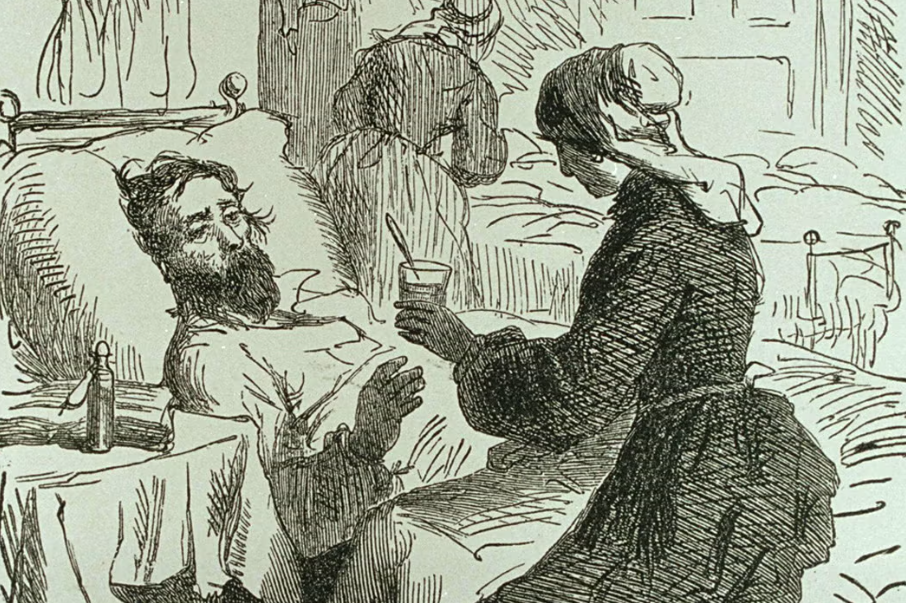
Image: A woman tending to a sick man, 1861 via Flickr
March is Women’s History Month, making it a meaningful time to recognize the growing impact of women in funeral, cemetery, and cremation professions. This month also included National Funeral Director and Mortician Recognition Day on March 11, a day dedicated to honoring the compassionate professionals who guide families through loss and help communities memorialize loved ones.
While funeral service was once widely seen as a male-dominated profession, history tells a more complex story. In fact, caring for the dead was traditionally women’s work long before funeral directing became a formal industry.
When Death Was Women’s Work
Before the rise of modern funeral homes in the nineteenth century, most deaths occurred in the home. During this time, women in the family or community typically handled the care of the deceased. They washed and dressed the body, prepared it for burial, and organized the wake or laying out of the dead. Some women even offered these services professionally as “layers-out of the dead,” preparing bodies for burial within their communities.
This began to change in the mid-1800s. The Civil War created a need to transport soldiers’ bodies long distances, which led to the rise of embalming and the development of undertaking as a formal profession. As funeral services became commercialized, the industry increasingly shifted toward male business owners and undertakers. By the late 1800s, city directories showed hundreds of male undertakers but very few women working in the profession.
Early Women Who Broke Barriers
Even during this transition, pioneering women helped shape the profession. One notable example is Henrietta Bowers Duterte, who became the first woman in the United States to own and operate a funeral home in the 1800s. She successfully ran the business in Philadelphia and even used it as part of the Underground Railroad, helping enslaved people escape to freedom. Women like Duterte demonstrated that funeral service could be both a profession and a platform for community leadership.
The Profession Comes Full Circle
Today, the profession is seeing another transformation. Women are entering funeral service in greater numbers than ever before, serving as funeral directors, embalmers, crematory operators, cemetery managers, educators, and business owners. Many mortuary science programs now report a majority of female students, suggesting that the next generation of funeral professionals will be increasingly female-led.
In many ways, the profession is coming full circle—returning to a long tradition of women playing central roles in death care and memorialization.
Honoring Funeral Professionals
The work of funeral professionals is also recognized in March during National Funeral Director and Mortician Recognition Day on March 11, which celebrates the dedication of those who support families through some of life’s most difficult moments.
Funeral service is a profession that blends technical expertise with empathy, compassion, and deep respect for families and communities.
Looking Ahead
As more women enter funeral service and leadership roles across the profession, the industry continues to evolve. Many women are shaping the future of funeral care through innovation, education, and compassionate service.
At AFCCA, we are proud to see so many talented women serving families across Arizona in funeral homes, cemeteries, and crematories. Their dedication strengthens the entire profession. During Women’s History Month, we celebrate the women who helped shape funeral service—and those who will continue to lead the profession into the future.
Learn More
When Death Was Women’s Business (JSTOR Daily)
https://daily.jstor.org/when-death-was-womens-business/
National Funeral Director & Mortician Recognition Day
https://www.nationaldaycalendar.com/national-day/national-funeral-director-and-mortician-recognition-day-march-11
Women in Funeral Service History
https://en.wikipedia.org/wiki/Women_in_death_care_in_the_United_States